

Why Does My Hisense AC Keep Turning Off? 8 Common Causes and DIY Fixes
A Hisense air conditioner that keeps shutting off unexpectedly is almost always protecting itself from damage. Air conditioners are designed with multiple safety sensors that cut power when something is wrong — a frozen coil, an overheating compressor, a clogged drain line, or a refrigerant pressure problem. The shutdown is a symptom, not the disease. The root cause is what triggered the sensor, and the most common trigger is a dirty air filter that restricts airflow, freezes the evaporator coil, and forces the unit into a protective shutdown cycle.
Before calling a technician, there are four checks you can do in 10 minutes that solve roughly 60% of Hisense AC shutdown problems: clean the air filter, verify the thermostat settings, check the timer and sleep mode, and make sure the outdoor condenser unit is not blocked by debris or overgrown vegetation. If those four checks do not fix the problem, the remaining causes require progressively more technical diagnosis — but each one has a specific set of symptoms that tells you which component is failing.
1. Dirty Air Filter: The Most Common Cause of AC Shutdown
A clogged air filter is the single most frequent reason a Hisense AC turns off by itself.
When the filter is packed with dust, pet hair, and debris, airflow across the evaporator coil drops below the minimum required for proper heat exchange.
The coil temperature drops below freezing, condensation on the coil turns to ice, and the ice layer grows until it blocks airflow entirely. The unit’s freeze sensor or low-temperature thermistor detects the condition and cuts power to the compressor to prevent damage.
Clean or replace the air filter every 30 days during heavy-use seasons and every 60 to 90 days during moderate use.
On most Hisense window and portable units, the filter slides out from the front or side panel without tools. Rinse it under warm water, let it dry completely, and reinstall it.
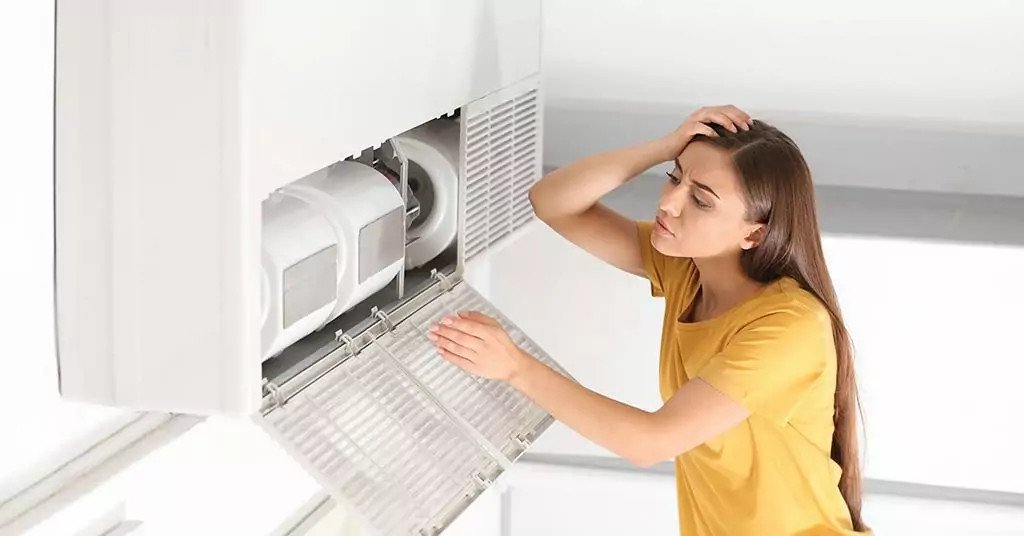
A Hisense mini-split or central system uses a washable filter behind the front cover: open the cover, lift the filter tabs, and rinse.
If the filter is torn, discolored, or has been in service for more than a year, replace it with a Hisense-compatible replacement (typically $10 to $25).
After cleaning the filter, leave the unit off for 30 to 60 minutes if the evaporator coil was frozen. Running the fan only (without the compressor) speeds up the thaw. Do not chip at the ice with a tool — a punctured evaporator coil is a $600 to $1,200 repair that a clean filter would have prevented.
2. Thermostat and Timer Settings: The Overlooked Simple Fix
A Hisense AC that reaches the set temperature and turns off is working correctly: the shutdown is normal thermostat cycling, not a malfunction.
The problem is only a problem if the unit turns off before the room reaches a comfortable temperature, or if it turns off and does not turn back on.
Check three settings on the remote control or the unit’s display panel before assuming a mechanical failure.
First, verify the thermostat is set 5°F to 10°F below the current room temperature. If the set temperature is at or near the room temperature, the unit reaches the target in minutes and shuts off (a behavior called short cycling).
Second, check whether the timer function is active. Many Hisense remotes have a TIMER ON or TIMER OFF button. If the display shows a clock icon or the word TIMER, press the timer button until the icon disappears.
Third, check whether SLEEP mode is enabled. Sleep mode gradually adjusts the temperature upward over several hours at night, which can make the unit appear to have shut off earlier than expected if you wake up in a warm room.
Quick remote control reset: Remove the batteries from the remote for 30 seconds, then reinsert them. A remote with low batteries can send intermittent or incorrect signals that cause the AC to behave erratically (turning on and off, changing modes, or ignoring commands. If the problem goes away with fresh batteries, it was never an AC problem.
3. Frozen Evaporator Coils: When Your AC Turns Into a Block of Ice
A frozen evaporator coil triggers the same protective shutdown as a dirty filter because the two problems are connected — a dirty filter is the most common cause of a frozen coil. But a frozen coil can also occur even with a clean filter if the refrigerant charge is low, the blower fan is failing, or the unit is running in cool mode when the outdoor temperature is below 60°F.
You can confirm a frozen coil without disassembling the unit. Open the front panel and look at the metal fins behind the filter. If you see a layer of frost or solid ice on the fins, the coil is frozen.
Turn the unit off immediately and switch the fan to high speed (cool mode off) to thaw the coil. Thawing takes 1 to 3 hours depending on the ice thickness.
Place towels under the indoor unit: melting ice will drip water that the drain pan may not catch.
If the coil freezes again within days of cleaning the filter and thawing the ice, the problem is likely a refrigerant leak or a failing blower fan motor. A Hisense unit with a refrigerant leak will gradually lose cooling capacity over weeks or months before the coil begins freezing regularly. A unit with a failing blower motor will make unusual noises — humming, rattling, or squealing — before the airflow drops enough to freeze the coil. Both problems require a licensed HVAC technician.
4. Condensate Drain Clog and Float Switch
Hisense portable and window AC units, as well as mini-split systems, use a condensate drain system to remove the water that condenses on the evaporator coil during normal operation.
When the drain line clogs with algae, mold, or debris, water backs up into the drain pan.
A float switch inside the pan rises with the water level and cuts power to the compressor and fan when the pan is nearly full. This safety mechanism prevents water from overflowing into the room or the wall.
A unit that shuts off after 15 to 30 minutes of cooling, consistently, with no error code on the display, is a classic float-switch shutdown. The unit runs long enough to produce enough condensate to fill the partially clogged pan, then the switch trips. After the unit has been off for an hour, enough water has drained or evaporated for the switch to reset, and the cycle repeats.
To clear a clogged condensate drain on a Hisense mini-split, locate the drain outlet (a small PVC or vinyl tube exiting the indoor unit near the wall penetration) and use a wet-dry vacuum to suction the blockage from the outside end of the tube.
Pour a cup of warm water mixed with a few drops of bleach into the drain pan (accessible behind the front cover) to kill algae inside the pan.
On a Hisense portable AC, the drain plug is on the back or bottom of the unit: remove the plug, drain the water into a shallow pan, and clean the drain port with a pipe cleaner or a small brush.
5. Overheating Compressor: The Outdoor Unit Shuts Down
A Hisense split-system or central AC that shuts down at the outdoor condenser unit rather than at the indoor air handler is experiencing compressor overheating. The compressor is an electric motor-driven pump that circulates refrigerant between the indoor and outdoor coils. When the compressor overheats — from dirty condenser coils, a failed condenser fan, or high ambient temperature — an internal thermal overload switch cuts power to the motor. The switch resets automatically after the compressor cools, and the unit restarts. Then the compressor overheats again, and the cycle repeats.
Check the outdoor condenser unit before calling a technician.
Clear away any leaves, grass clippings, weeds, or debris within 2 feet of the unit on all sides. The condenser coils on the sides of the unit should be clean and free of cottonwood fluff, dryer lint, or caked-on dirt.
Clean the coils with a garden hose (not a pressure washer) by spraying from the inside outward to push debris out of the fins rather than deeper into them.
Straighten any bent fins with a fin comb ($8 to $15 at a hardware store). Bent fins restrict airflow through the coil just as effectively as a clogged filter.
If the condenser fan is not spinning when the compressor is running, the fan motor or the fan capacitor has failed. A humming outdoor unit with a stationary fan is a failed capacitor — a $15 to $40 part that takes a technician 30 minutes to replace and costs $150 to $300 including labor. Do not attempt to replace a capacitor yourself. Capacitors store electricity even when the power is off and can deliver a fatal shock.
6. Refrigerant Leak and Low-Pressure Cutoff
A Hisense AC that shuts down shortly after starting, with weak or warm airflow, may have a refrigerant leak. Air conditioners are sealed systems — refrigerant does not get “used up” over time. If the refrigerant level is low, there is a leak somewhere in the system, and the leak must be found and repaired before the system is recharged.
The low-pressure switch on the suction line detects the drop in refrigerant pressure and cuts power to the compressor to prevent it from running without adequate lubrication and cooling. A unit that starts, runs for 30 to 60 seconds, and shuts off repeatedly — a behavior called short cycling — is a textbook low-pressure cutoff pattern.
Other signs of a refrigerant leak include oily residue on the refrigerant lines (refrigerant carries compressor oil, and the oil escapes at the leak point), a hissing or bubbling sound from the indoor or outdoor unit, and a gradual loss of cooling capacity over weeks or months. Refrigerant leaks require an EPA-certified technician with a leak detector, recovery equipment, and the correct refrigerant for your Hisense model — typically R-410A for units manufactured in the last 15 years or R-32 for newer models. A leak repair and recharge costs $400 to $1,500 depending on the leak location and the amount of refrigerant needed.
7. Electrical Problems: Breakers, Outlets, and Voltage Drop
A Hisense AC that trips the circuit breaker or shuts off due to a power interruption is experiencing an electrical problem, not a mechanical one. Window and portable units that share a circuit with other appliances can overload the breaker when the compressor starts. A compressor draws three to five times its running current for a fraction of a second at startup — called locked rotor current or inrush current — and a 15-amp breaker that is already carrying 8 to 10 amps from other loads will trip when the compressor kicks on.
Plug the Hisense unit into a dedicated outlet on its own circuit. If no dedicated circuit is available, unplug or turn off everything else on that circuit before running the AC. Window units drawing more than 7.5 amps require a dedicated circuit per the DOE and National Electrical Code — check the unit’s nameplate for the amp rating. A 12,000 BTU Hisense window AC typically draws 8 to 10 amps.
An extension cord is never the correct solution for a tripping breaker. Extension cords add resistance to the circuit, causing voltage drop at the unit. Low voltage causes the compressor to draw more current to produce the same power, which generates more heat, which trips the thermal overload. The unit shuts down, cools off, restarts, and trips again — a cycle that destroys the compressor over time. Plug the unit directly into a wall outlet. If the cord does not reach, have an electrician install a new outlet closer to the window.
8. Hisense-Specific ECO and Sleep Mode Behavior
Hisense air conditioners include several energy-saving modes that can be mistaken for a malfunction. Understanding how they work prevents unnecessary service calls.
ECO mode reduces the compressor speed and fan speed to save energy once the room reaches approximately 80% of the set temperature. The unit continues to run, but the airflow feels weaker and the cooling is less aggressive. If the room temperature rises above the ECO threshold, the unit ramps back up. This cycling between low and normal operation can feel like the unit is turning off when it is actually just reducing output.
Sleep mode gradually increases the set temperature by 1°F to 2°F per hour over the first several hours of operation, then holds at the final temperature. By morning, a unit that was set to 68°F at bedtime may be maintaining 74°F or higher. The unit did not turn off — it followed a programmed temperature curve. If you wake up warm, check the remote for the sleep mode icon (usually a moon or star symbol) and disable it before bed if you prefer a constant temperature through the night.
The FOLLOW ME feature on some Hisense remotes uses a temperature sensor in the remote itself rather than the sensor at the indoor unit. If the remote is placed in direct sunlight, near a heat source, or under a blanket, it reads an abnormally high temperature and runs the compressor continuously until the remote’s sensor reads the setpoint — which it never will if the remote is in the sun. Move the remote to a shaded location at the same height as the thermostat would be installed, away from windows and heat sources.
FAQ: Common Questions About Hisense AC Shutdown Problems
Why does my Hisense AC turn on and off every few minutes?
Short cycling — the unit runs for 1 to 5 minutes, shuts off, then restarts a few minutes later — is caused by an oversized AC for the room, a thermostat sensor that is too close to the cold air outlet, or a failing capacitor that cannot maintain the compressor through a full cycle. An oversized unit cools the room so fast that the thermostat satisfies before the compressor has run long enough to dehumidify. The fix is replacing the unit with a correctly sized one — 20 BTU per square foot of room area, per DOE sizing guidelines.
My Hisense AC displays an error code. What should I do?
Hisense units use error codes to indicate specific faults. E1 is a room temperature sensor failure. E2 is an evaporator coil sensor failure. E4 is a compressor overload or overcurrent fault. F0 is a refrigerant leak or low-pressure fault. Write down the exact code from the display, unplug the unit for 5 minutes to reset the control board, and plug it back in. If the code reappears, the fault is real and requires service. If the code does not reappear, it was a transient sensor reading and the unit can be used normally. Take a photo of the code before resetting so the technician knows what they are diagnosing.
Work Through the Simple Fixes Before Calling a Technician
A Hisense AC that shuts off is not broken — it is protecting itself from a condition that will cause damage if it keeps running. The shutdown is the symptom, and the root cause is upstream of the safety sensor that triggered it.
Work through the list in order: clean the filter, check the timer and thermostat, thaw a frozen coil, clear the condensate drain, clean the outdoor condenser, and verify the electrical circuit. Those six steps solve the majority of Hisense shutdown problems at zero cost. If the unit is still shutting down after all six checks, the problem is in the sealed refrigerant system or the control electronics, and that is the point to call a licensed HVAC technician.